
An inherited IRA can look simple on paper and messy in practice. The account does not follow normal retirement-account habits once the owner dies, so the beneficiary has to think about timing, taxes, and ownership rights at the same time. I’m going to separate the rules that actually matter from the noise so the next move is a deliberate one.
The fastest path is to match the beneficiary type to the deadline
- The beneficiary form usually controls who gets the money, not the will.
- Most non-spouse beneficiaries who inherited after 2019 face a 10-year distribution deadline.
- A surviving spouse usually has the most flexibility and may be able to roll the assets into a personal IRA.
- Traditional withdrawals are generally taxed as ordinary income; Roth withdrawals are often tax-free if the five-year clock has run.
- Missing a required withdrawal can trigger a 25% excise tax, so deadlines matter.
What changes the moment the owner dies
I treat the account as a tax clock with a beneficiary attached. The money may still grow tax-deferred or tax-free, but the rules change immediately because the beneficiary is no longer following owner rules. That is why I start with two questions: what kind of IRA it is, and who is legally entitled to it.
| Account type | How withdrawals are usually taxed | What matters most |
|---|---|---|
| Traditional account | Usually taxed as ordinary income | Timing withdrawals to avoid pushing income into a higher bracket |
| Roth account | Often tax-free if the Roth five-year clock has been met | The distribution deadline still matters even when the tax bill is lighter |
That split matters more than most people expect. A traditional account is mostly a tax deferral problem. A Roth account is more of a timing problem. In both cases, the real mistake is assuming the beneficiary can simply treat the money like their own retirement savings without checking the rules first. Once that baseline is clear, the next step is figuring out who has the widest set of choices.
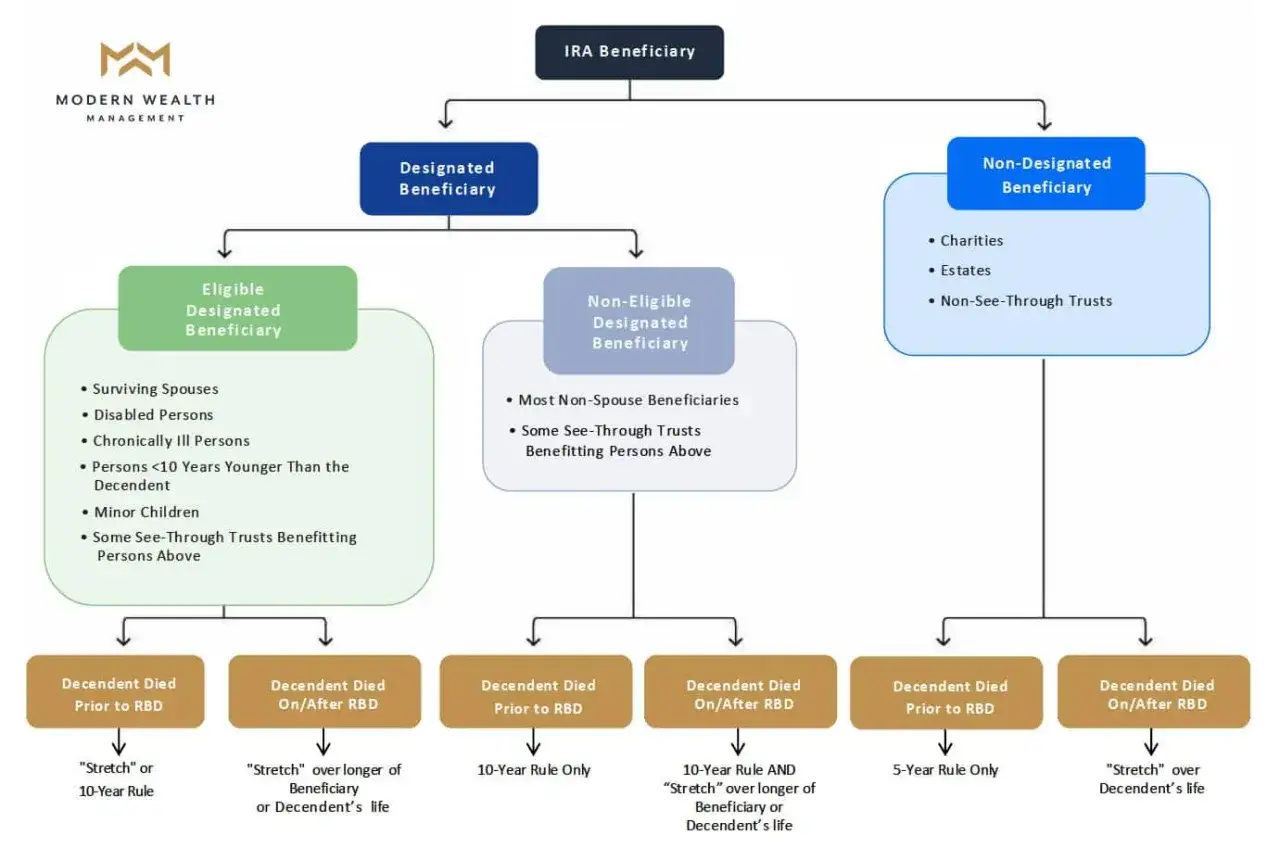
Who gets the widest choices and why beneficiary type matters
The IRS gives a surviving spouse more flexibility than anyone else, especially if the spouse is the sole beneficiary. Non-spouse beneficiaries usually have a tighter clock, and estates, charities, and certain trusts can be tighter still. I always map the beneficiary category before I touch the distribution strategy, because this one variable changes almost everything else.
| Beneficiary type | Main options | Practical takeaway |
|---|---|---|
| Surviving spouse | May be able to roll assets into a personal IRA or keep the account inherited and use spouse-specific timing rules | Best for long-term control, but the best choice depends on age, income needs, and whether the spouse needs early access |
| Non-spouse designated beneficiary | Usually subject to the 10-year rule; annual withdrawals may also apply in some cases | Best planning focus is tax smoothing over the distribution window |
| Eligible designated beneficiary | May qualify for life-expectancy payouts or, in some cases, the 10-year rule | This category includes a surviving spouse, a minor child, a disabled or chronically ill individual, or someone not more than 10 years younger than the owner |
| Estate, charity, or certain trusts | Usually falls into less favorable non-individual rules | These cases need extra care because the outcome is often less flexible than people assume |
One detail that gets overlooked: if there are multiple beneficiaries, separate accounts often need to be set up on time to preserve the best distribution method. When that step is skipped, the oldest beneficiary can end up driving the schedule for everyone else. If a trust is involved, I slow down even more, because trust wording can change the distribution math in ways that are easy to miss. That leads directly to the part most people ask about first, which is the actual deadline.
How the 10-year clock and required withdrawals work
For deaths in 2020 or later, most non-spouse beneficiaries must empty the account by December 31 of the 10th year after the year of death. If the original owner had already reached required minimum distribution age, annual withdrawals may also apply in years 1 through 9. If the owner had not yet reached that stage, the timing can be simpler, but only if the beneficiary category allows the 10-year approach.| Situation | What usually happens | Example |
|---|---|---|
| Owner died in 2026 before RMD age | Often no annual beneficiary withdrawals, but the balance still has to be gone by year 10 | If death was in 2026, the account generally must be fully distributed by December 31, 2036 |
| Owner died in 2026 after RMDs had started | Annual withdrawals may be due during the 10-year period, plus the year-10 cleanout | Waiting until the last year can create a large taxable withdrawal |
| Roth account inherited by a non-spouse | Often the same 10-year clock applies, but many withdrawals are tax-free if the Roth five-year clock was met | The account can still be time-limited even when the tax bite is lighter |
| Death occurred before 2020 | Different legacy rules may still apply | Older stretch-style treatment may still be relevant |
- The original owner’s final-year required withdrawal does not disappear.
- The deadline can shift when there are multiple beneficiaries, a trust, or a spouse election.
- For 2026, IRA owners generally begin their own required withdrawals at age 73, so the date of death matters a lot.
- When in doubt, I ask the custodian to confirm the exact deadline before any money moves.
This is the point where many beneficiaries get trapped by indecision. They wait, assume the custodian will handle everything, and then discover the tax calendar was never forgiving in the first place. The safest habit is to verify the first required withdrawal date, the year-10 deadline, and whether the deceased had already started taking RMDs. After that, the tax side becomes much easier to manage.
Taxes, penalties, and the mistakes I see most often
Tax treatment is straightforward in concept and easy to mishandle in practice. Traditional-account distributions are generally ordinary income. Roth-account distributions are often tax-free if the five-year Roth clock has been satisfied. The usual 10% early-withdrawal penalty generally does not apply to beneficiary distributions, which is one reason the inherited structure is so different from a personal retirement account.
- Using a 60-day rollover when a direct trustee-to-trustee transfer was needed can turn a clean transfer into a taxable distribution.
- Treating the account like your own when you are not the surviving spouse usually creates avoidable problems.
- Missing the year-of-death withdrawal or the 10-year deadline can trigger an excise tax. The current penalty is generally 25% of the amount not taken, and timely correction can reduce it.
- Ignoring multiple beneficiaries can leave everyone stuck with a less favorable distribution schedule.
- Assuming the will overrides the beneficiary form is a classic estate-planning error that I see more often than I should.
I also watch for a subtler mistake: rolling assets into a personal IRA too quickly just because it sounds cleaner. That can be the right move for a spouse, but it can be a bad move if the beneficiary is under 59½ and needs flexibility. Once the money is treated as personal retirement savings, the old rules come back into play. The better answer is usually the one that fits the beneficiary’s age, tax bracket, and cash needs, not the one that looks neatest on paper.
The decision framework I use before the first withdrawal
At this point, the right answer is less about the account itself and more about the person holding it. When I’m mapping out a plan, I look at cash needs, tax brackets, and whether the beneficiary wants simplicity or maximum deferral. A good plan is usually boring: it avoids surprises and keeps the IRS from becoming the loudest voice in the process.
| Your goal | Usually sensible move | Main trade-off |
|---|---|---|
| Maximize tax deferral | Keep the account inherited and spread withdrawals across the allowed years | Requires discipline and deadline tracking |
| Need steady retirement income | Take planned withdrawals instead of waiting for a year-10 rush | Current-year income may still rise |
| Surviving spouse wants long-term control | Consider rolling assets into a personal IRA | Own-IRA rules apply, including age-59½ early-withdrawal limits |
| Spouse needs access before 59½ | Keeping the account inherited can preserve more flexibility | Less simplicity, more account-level rules to manage |
| Want the cleanest possible exit | Withdraw on a deliberate schedule and close the account before the deadline arrives | Potentially larger tax bill in the near term |
My practical checklist is simple: confirm the beneficiary class, verify whether the owner had already reached the RMD stage, ask the custodian how the account should be retitled, and map the withdrawals against your other income for the year. If there is a trust, a minor child, or a disability-related exception involved, I would get the tax and estate details checked before the first distribution goes out. That is usually the difference between a controlled transfer and a very expensive guessing game.
What to lock in before the year-end clock starts
The main job is to match the beneficiary type to the deadline, then decide whether the account should be stretched, spent down, or rolled over by a surviving spouse. If I had to reduce the whole topic to one rule, it would be this: get the facts first, then choose the tax path. The wrong assumption at the start tends to cost far more than the right distribution strategy saves later.
Before taking the first dollar, I would confirm three things and keep them in writing: who the beneficiary is, whether the original owner had begun required withdrawals, and which calendar date ends the account’s life. Once those are locked in, the account stops being a mystery and starts behaving like a planning problem you can actually solve.